Employee productivity has a direct impact on business performance. It influences operating costs, service quality, delivery times, production output, and overall profitability.
Yet measuring and improving employee productivity is not as simple as counting completed tasks or comparing the number of hours worked.
Employees can be busy throughout the day without producing the expected results. Processes may create unnecessary work, equipment may cause delays, or workloads may be poorly distributed. In other cases, employees may lack the training, information, or motivation needed to perform effectively.
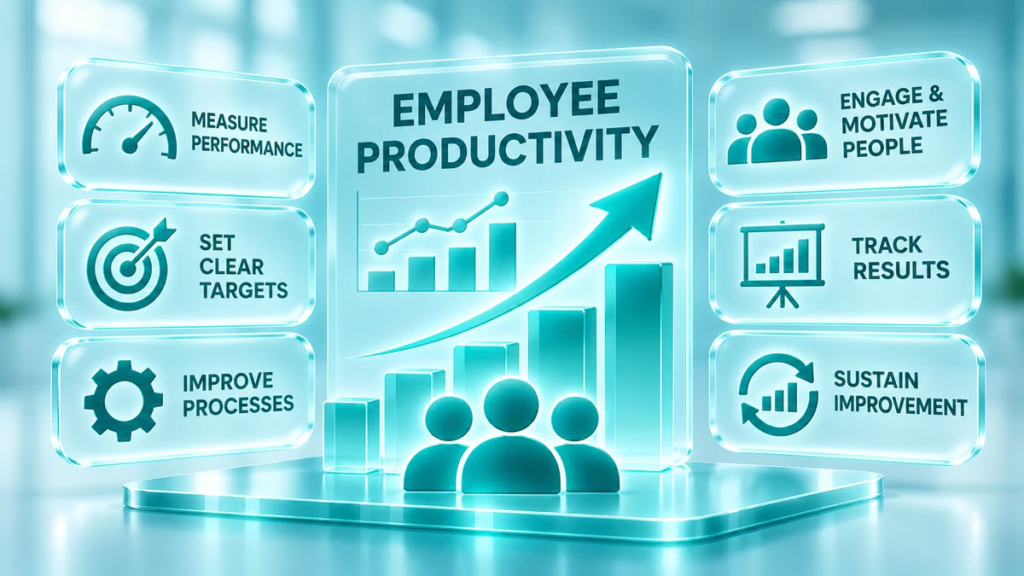
Sustainable productivity improvement requires a structured approach that combines performance measurement, process improvement, effective management, and employee engagement.
This article explains how businesses can measure employee productivity, identify improvement opportunities, and sustain better performance over time.
1. Understand What Employee Productivity Really Means
Employee productivity measures the relationship between the output achieved and the resources used to achieve it.
In simple terms:
Employee Productivity = Output / Labour Input
The output may be units produced, orders processed, customer requests resolved, projects completed, or another measurable result.
Labour input is commonly measured in working hours, although some businesses also consider the number of employees or total labour costs.
For example:
A warehouse team processes 1,600 order lines using 80 direct labour hours.
1,600 / 80 = 20 order lines per labour hour
This indicator shows how much output the team achieves for each hour of direct labour.
However, productivity should never be evaluated in isolation. A team that processes more orders but makes significantly more errors may not be performing better overall.
A balanced approach considers:
- Output and productivity
- Quality and error rates
- Working hours and labour utilisation
- Customer service and delivery performance
- Safety and compliance
- Employee engagement and sustainability
Practical tip: Define productivity according to the actual work being performed. The most useful measure for a warehouse picker will be different from the most useful measure for a customer service specialist or production operator.
2. Choose the Right Employee Productivity KPIs
A good productivity measurement system uses indicators that reflect both the quantity and quality of work.
The choice of KPIs depends on the business model, department, and employee responsibilities.
Here are examples of useful productivity indicators:
| KPI | What It Measures |
|---|---|
| Output per labour hour | Output achieved for each working hour |
| Tasks completed per employee | Number of completed tasks within a defined period |
| Revenue per employee | Revenue generated relative to workforce size |
| Labour cost per unit | Labour cost required to produce one unit |
| First-time-right rate | Share of tasks completed correctly without rework |
| Employee utilisation | Share of available working time spent on defined productive activities |
| Absenteeism rate | Level of employee absence |
| Overtime hours (%) | Dependence on additional working hours |
Not every KPI should be applied to every role.
For example, revenue per employee may be useful at company or department level, but it may not fairly reflect the contribution of an individual warehouse operator.
Similarly, measuring the number of customer calls handled without considering resolution quality may encourage employees to prioritise speed over service.
Practical tip: Select a small group of KPIs that employees can understand and influence. Combine productivity indicators with quality and service measures to avoid creating the wrong incentives.
3. Establish a Reliable Productivity Baseline
Before setting productivity targets, understand the current level of performance.
A baseline provides a reference point for measuring improvement and identifying differences between teams, shifts, processes, or locations.
To establish a reliable baseline:
- Define the activity or output being measured.
- Agree on which labour hours are included.
- Collect data over a representative period.
- Account for differences in workload and task complexity.
- Check the accuracy and consistency of the data.
- Calculate the average and review performance variation.
For example:
A team processes 12,000 units over 600 direct labour hours.
12,000 / 600 = 20 units per labour hour
This becomes the baseline for future comparisons.
However, averages can hide important differences. Productivity may vary between shifts because of different order profiles, machine availability, staffing levels, or product complexity.
Comparisons should therefore be made between similar activities and operating conditions.
Practical tip: Use a representative period rather than relying on one unusually good or poor day. Understand the reasons for performance variation before setting improvement targets.
4. Identify What Is Limiting Employee Productivity
Low productivity is not necessarily caused by a lack of employee effort.
In many organisations, employees lose time because of problems within the working environment or process design.
Common productivity barriers include:
- Poorly organised workflows
- Excessive movement and unnecessary handling
- Equipment breakdowns or limited availability
- Missing materials or information
- Unclear responsibilities and priorities
- Inefficient communication between departments
- Rework caused by errors
- Inadequate training
- Uneven workloads and poor workforce planning
For example, a warehouse picker may appear less productive than colleagues because the assigned picking zone has longer travel distances or frequent replenishment delays.
Increasing the employee’s target will not solve the underlying problem.
Managers should observe the actual work, analyse process data, and speak with employees to understand where time and capacity are being lost.
Practical tip: Before introducing individual performance targets or additional pressure, investigate whether the process gives employees the tools and conditions needed to perform effectively.
5. Improve Productivity Through Better Work Organisation
Once the main productivity barriers have been identified, focus on improving how work is organised.
Small process improvements can create significant gains when repeated across many employees and working hours.
Practical actions include:
- Simplifying unnecessary process steps
- Improving workplace and warehouse layout
- Standardising working methods
- Balancing workloads between employees and teams
- Reducing waiting time and interruptions
- Improving material and information availability
- Ensuring equipment is ready when needed
- Matching staffing levels to workload
For example, if employees spend too much time searching for tools, materials, or information, better organisation and standardised storage can reduce wasted time.
In a warehouse, improved slotting and picking routes may reduce unnecessary travel. In production, better line balancing may prevent employees from waiting for work or creating bottlenecks.
Practical tip: Prioritise improvements that remove recurring sources of wasted time. Do not assume that working faster is the best way to increase productivity.
6. Develop Skills and Employee Motivation
Employee capability and motivation both influence performance.
Even well-designed processes cannot deliver consistent results if employees do not have the necessary skills, knowledge, or confidence to perform their tasks.
Training should focus on the competencies required for each role, including:
- Technical and operational skills
- Correct use of systems and equipment
- Quality and safety standards
- Problem-solving abilities
- Communication and teamwork
- Understanding of performance expectations
Motivation is equally important.
Employees are more likely to take ownership of their performance when they understand expectations, receive constructive feedback, and see that their contribution is recognised.
Effective management practices include:
- Setting clear and achievable goals
- Providing regular feedback
- Recognising improvements and good performance
- Involving employees in process improvement
- Offering opportunities for skill development
- Ensuring fair and transparent performance evaluation
Financial incentives can support productivity, but they should be designed carefully. Rewarding output alone may encourage shortcuts, lower quality, or unhealthy competition.
Practical tip: Connect employee recognition and incentives with balanced results – productivity, quality, safety, and teamwork – rather than rewarding one metric in isolation.
7. Use Performance Management to Sustain Results
Productivity improvement should not be treated as a one-time initiative.
Without regular monitoring and management attention, performance often returns to previous levels.
A consistent performance management routine helps maintain focus and identify problems before they become significant.
A practical routine can include:
Daily
- Review key operational results.
- Identify deviations from the plan.
- Discuss immediate obstacles.
- Agree on actions and responsibilities.
Weekly
- Review productivity trends.
- Analyse recurring problems.
- Check progress on improvement actions.
- Identify training or resource requirements.
Monthly
- Evaluate performance against targets.
- Review quality, labour costs, and service levels.
- Assess whether improvement actions are delivering results.
- Adjust priorities and targets where necessary.
Managers should use performance information to understand what is happening and support improvement, not simply to rank employees.
Practical tip: Make performance reviews action-oriented. Every significant performance gap should lead to an investigation, a decision, or a clearly assigned action.
8. Use Data and Technology to Support Productivity Management
As businesses grow, manually collecting and analysing employee productivity data becomes increasingly difficult.
Information may be spread across ERP systems, warehouse management systems, production systems, time records, and spreadsheets.
This makes it difficult to obtain a consistent view of performance.
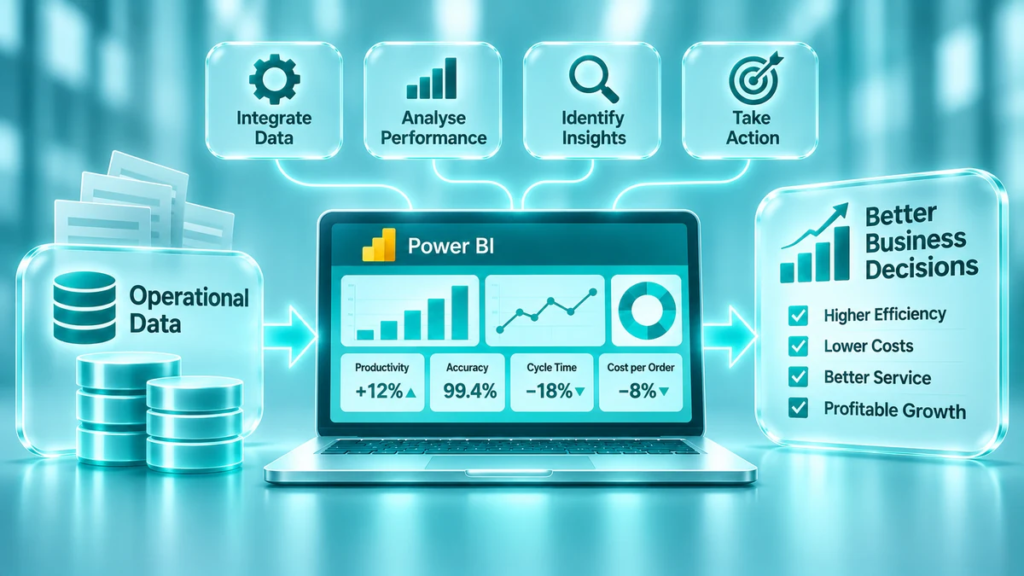
Data integration and visual dashboards can help managers:
- Monitor productivity by department, shift, or process
- Compare actual results with targets
- Identify performance trends
- Understand labour utilisation
- Detect recurring bottlenecks
- Track the impact of improvement actions
Tools such as Microsoft Power BI can bring information from different sources into a shared performance dashboard.
However, technology should support a well-defined management process. Automating unclear or inconsistent KPI calculations will not solve the underlying measurement problems.
Practical tip: Start with clear KPI definitions and reliable data sources. Automate reporting once the business understands what it needs to measure and how the results will be used.
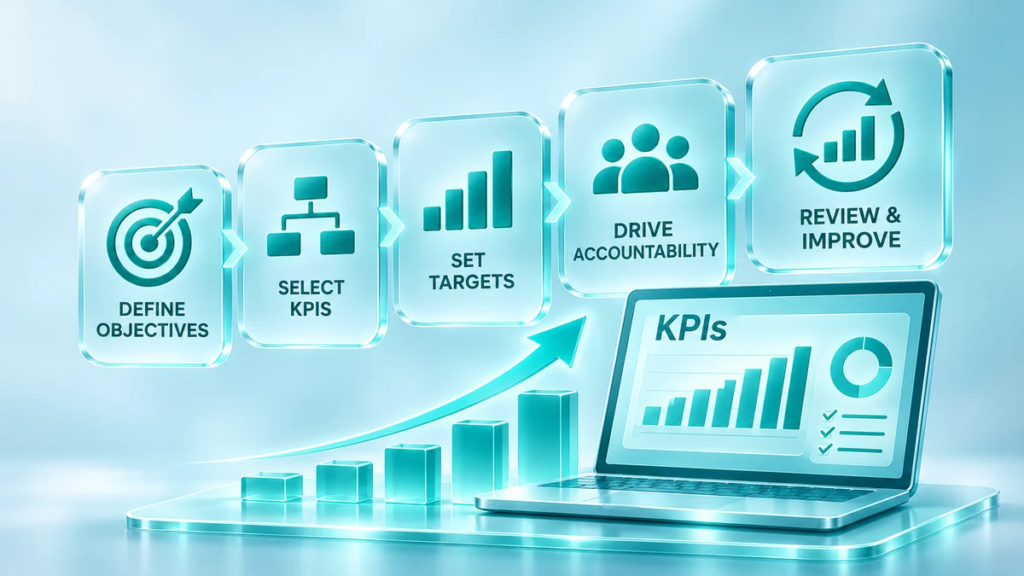
How to Build a Sustainable Employee Productivity Improvement Cycle
The most effective organisations treat productivity as an ongoing management responsibility.
A simple improvement cycle can help:
- Measure: Establish the current productivity baseline.
- Understand: Identify the main barriers affecting performance.
- Improve: Change processes, resources, or working methods.
- Engage: Involve employees and develop the required skills.
- Review: Measure the impact of improvements.
- Sustain: Standardise successful practices and continue monitoring results.
This approach helps businesses avoid short-term productivity gains that create additional costs, quality problems, or employee dissatisfaction.
Conclusion: Improve the System, Support the People, Sustain the Results
Employee productivity is influenced by much more than individual effort.
It depends on effective processes, suitable working conditions, clear expectations, employee skills, motivation, and consistent performance management.
Businesses that want to achieve sustainable productivity improvements should:
- Measure output in relation to labour input.
- Balance productivity with quality and service.
- Establish reliable baselines and realistic targets.
- Identify process-related productivity losses.
- Improve work organisation and resource utilisation.
- Develop employee skills and motivation.
- Review performance regularly.
- Use reliable data to guide decisions.
The objective is not simply to make employees work harder. It is to create an environment in which people can perform effectively and deliver better results.
TOP KPI helps businesses measure employee productivity, improve operational processes, and establish performance management systems that connect employee contribution with measurable business results.
Explore our AUDIT, DATA, MOTIVATION, and POWER BI solutions to build a more productive and performance-focused organisation.